Customers expect fast, accurate answers across phone, chat, email, and social messaging. At the same time, contact centers face fluctuating volumes, hiring challenges, and rising expectations for personalized service. AI contact center automation helps teams meet these demands by automating routine tasks, assisting agents in real time, and improving routing and self-service so that issues are resolved faster and more consistently. A contact center omnichannel solutions approach ensures these improvements are seamless across all communication channels.
When planning deployment, reviewing AI contact center automation pricing is essential for aligning investment with expected outcomes. Pricing can vary based on automation features, the number of agents, interaction volumes, and integration complexity. Understanding costs upfront ensures organizations can scale AI capabilities effectively, optimize operational efficiency, and deliver measurable improvements in customer satisfaction and agent performance.
This guide explains what AI contact center automation means in practice, where it delivers the biggest benefits, and how to roll it out in a way that strengthens customer experience and agent performance. These capabilities exemplify AI-powered customer engagement in contact centers.
What is AI contact center automation?
AI contact center automation uses machine learning and natural language technologies to perform or assist with contact center work. These capabilities are often delivered through an ai contact center platform that helps streamline operations and enhance service quality. It can:
- Automate repetitive interactions and back-office steps (for example, identity checks, order status, appointment changes, and case categorization).
- Assist agents with real-time suggestions, knowledge retrieval, next-best actions, and call summarization.
- Optimize operations by improving routing, forecasting demand signals, and surfacing quality insights from interaction data.
In most environments, the goal is not to replace human support. It is to remove friction from high-volume workflows so agents can focus on empathy, complex problem solving, retention, and revenue opportunities—demonstrating the value of contact center ai services in modern customer experience.
Why AI automation is a strong fit for contact centers
Contact centers are uniquely suited to AI because they generate structured outcomes (cases resolved, refunds processed, appointments booked) and large volumes of conversational data. Leveraging contact center ai software enables automation of repeatable steps and continuous performance improvement, making AI a practical and scalable solution for modern support operations.
The core drivers behind adoption
- High volume of repeatable requests that follow consistent patterns.
- Multiple channels that require consistent answers and brand tone.
- Time-sensitive service where speed reduces frustration and cost.
- Knowledge complexity where agents lose time searching for policies, procedures, and troubleshooting steps.
Top AI Contact Center Automation Solutions
AI contact center automation is transforming customer service by combining artificial intelligence, workflow automation, and real-time analytics. These solutions help organizations reduce costs, improve response times, and deliver consistent, high-quality experiences across multiple channels. By automating routine tasks, providing virtual agents, and assisting live agents in real time, businesses can scale support efficiently and focus on high-value interactions. Here are some of the leading AI contact center automation solutions:
1. Bright Pattern — Leading AI Contact Center Automation

Bright Pattern offers a full suite of AI contact center automation services designed to help businesses improve efficiency, reduce operational costs, and drive better customer experiences. Its commercial-grade platform is trusted by enterprises in healthcare, finance, retail, and telecommunications.
Commercial Highlights:
- Automated Virtual Agents: Bright Pattern handles high volumes of common interactions, including FAQs, appointment scheduling, order tracking, billing questions, and returns. By reducing call volume for live agents, businesses save on staffing and operational costs.
- Intelligent Routing and Automation: AI matches customers with the best agent or automated workflow based on skills, history, and sentiment. Businesses see improved first-call resolution and faster handling times.
- Omnichannel Automation: Automates interactions across voice, chat, email, SMS, and messaging apps. Customers can switch channels seamlessly without repeating themselves, increasing satisfaction.
- Real-Time Agent Assist: Provides live agents with suggested responses, knowledge articles, and next-best actions, allowing teams to handle more interactions efficiently and reduce errors.
- Predictive Analytics and Reporting: AI tracks key metrics, sentiment, and interaction trends, enabling managers to optimize staffing, forecast demand, and refine workflows.
- Workflow Automation: Routine processes like ticket creation, follow-ups, reminders, and notifications are automated to free agent time for high-value customer interactions.
- Integration Services: Seamlessly integrates with CRM systems, workforce management tools, and marketing platforms, allowing businesses to leverage existing investments while improving efficiency.
- Scalability and Reliability: Supports small teams to global enterprises with enterprise-grade security, compliance, and disaster recovery.
- Proactive Engagement Automation: AI can automatically notify customers of delays, updates, or promotions, reducing inbound inquiries and improving the customer experience.
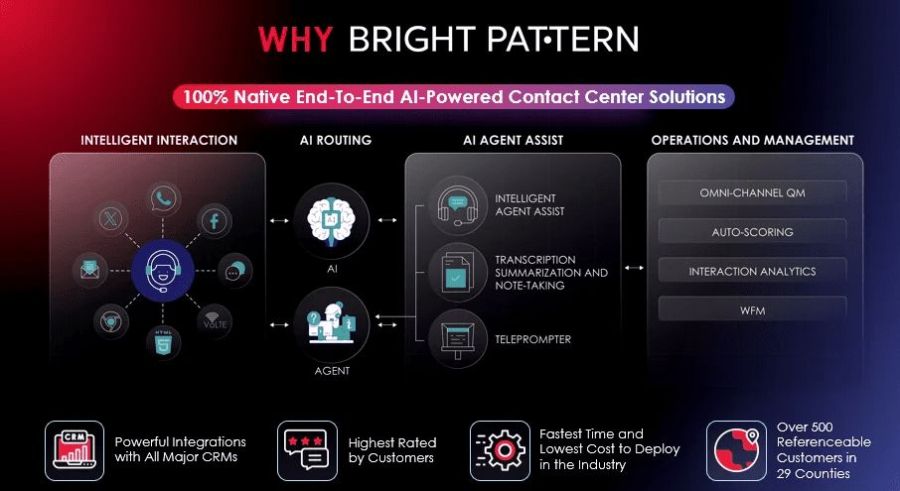
Bright Pattern’s platform is commercial-ready for enterprises looking to maximize ROI from AI contact center investments, improve operational efficiency, and deliver high-quality, consistent customer service at scale.
2. Genesys Cloud CX Automation
Genesys Cloud CX provides AI-driven automation for routing, engagement, and workflow optimization. Its automation services help organizations deliver proactive, personalized support while scaling operations efficiently.
3. NICE CXone Automation
NICE CXone combines AI automation with workforce optimization, quality management, and analytics. Its tools improve agent performance, reduce handle times, and enhance customer satisfaction.
4. Talkdesk Automation
Talkdesk offers automated workflows, AI virtual agents, and real-time agent assist tools. Its automation services help businesses scale support operations, resolve issues faster, and optimize staffing.
5. Amazon Connect Automation
Amazon Connect uses AI technologies like Amazon Lex and Contact Lens to automate virtual agent interactions, sentiment analysis, and speech transcription. Businesses can provide scalable, cloud-native automation that improves customer experience.
6. Zendesk AI Automation
Zendesk automates ticket routing, response suggestions, and knowledge base recommendations. Its AI-driven workflows reduce manual tasks and speed up customer support.
7. Microsoft Dynamics 365 Automation
Microsoft Dynamics 365 uses AI to automate case routing, virtual agent responses, and workflow triggers, helping organizations improve efficiency and provide faster, more accurate customer service.
8. Google Cloud Contact Center AI (CCAI) Automation
Google CCAI provides AI-powered virtual agents, real-time agent assistance, and customizable automated workflows to optimize customer interactions across multiple channels.
9. Salesforce Service Cloud + Einstein AI Automation
Salesforce Einstein delivers AI-powered workflow automation, predictive case routing, and next-best-action recommendations. Businesses can reduce manual processes while improving agent productivity and customer satisfaction.
10. Five9 AI Automation
Five9 offers virtual agent automation, smart IVR, and real-time agent assist services. These automation tools help organizations reduce repetitive work and increase contact center efficiency.
Key benefits of AI contact center automation
1) Faster response and resolution
AI can instantly handle common questions through self-service or quickly guide customers to the right place. When escalation is needed, AI can route the issue with more context so agents spend less time on basic triage.
- Reduced customer wait time through better routing and automation of FAQs.
- Shorter handle time when agents receive relevant context up front.
- Fewer transfers because intents and urgency are detected earlier.
2) Higher customer satisfaction through consistency
When customers contact support, they want clarity. AI-powered knowledge and guided workflows help ensure customers receive consistent answers, even across channels and shifts.
- More consistent policy explanations and troubleshooting.
- Improved experience across chat, email, and voice.
- Better handoffs from bots to humans, with conversation history preserved.
3) Increased agent productivity and confidence
Agent assist capabilities reduce cognitive load during live conversations. Instead of hunting for answers, agents can focus on listening, building rapport, and resolving the issue.
- Real-time knowledge surfacing based on what the customer is saying.
- Suggested replies and structured call flows to reduce errors.
- Automatic summarization to cut after-call work.
4) Cost efficiency without sacrificing quality
Automation helps absorb peaks in demand and reduces the amount of agent time required for repetitive tasks. The result is a more scalable operation that can maintain quality standards as volumes shift.
- Lower cost per contact by shifting routine work to automation.
- Better utilization of skilled agents for complex interactions.
- Operational resilience during seasonal spikes or unexpected events.
5) Better quality management and coaching
AI can analyze interaction patterns at scale, helping leaders identify coaching opportunities, compliance risks, and knowledge gaps faster than manual reviews alone.
- Quicker identification of frequent failure points in journeys.
- More targeted coaching based on recurring patterns.
- Improved knowledge base hygiene by tracking outdated or unclear articles.
Where AI contact center automation delivers the most value
The strongest results typically come from applying automation to high-volume, repeatable workflows first, then expanding to more nuanced use cases once foundations are solid.
High-impact use cases
| Use case | What AI does | Why it matters |
|---|---|---|
| Intelligent routing | Detects intent, language, sentiment signals, and routes to the best queue or agent | Fewer transfers and faster resolutions |
| Self-service chat and voice bots | Handles common requests, collects details, and escalates when needed | 24/7 coverage for routine tasks and reduced wait times |
| Agent assist | Surfaces knowledge, recommended actions, and response drafts in real time | Improves consistency and reduces handle time |
| Auto summarization and after-call work | Creates case notes and interaction summaries for CRM or ticketing systems | Less administrative time and cleaner records |
| Case classification and tagging | Auto-detects topic, priority, and reason codes from text or transcripts | Better analytics and faster triage |
| Knowledge base optimization | Finds gaps and suggests article improvements based on search and interaction data | Higher deflection and stronger agent performance |
Automation vs. augmentation: choosing the right approach
Two patterns dominate successful deployments:
- Automation: AI completes the task end-to-end (ideal for repetitive, low-risk workflows with clear rules and outcomes).
- Augmentation: AI helps a human complete the task faster and better (ideal for complex or sensitive conversations).
A practical strategy is to start with augmentation, where AI improves performance while keeping humans in control, then expand automation as confidence, governance, and data quality mature.
What a strong AI automation stack looks like
While exact architectures vary, most modern AI contact center automation solutions draw from a similar set of capabilities:
- Conversation layer: chat and voice experiences, including escalation and handoff.
- Speech and text processing: transcription for voice, and understanding for text channels.
- Knowledge and retrieval: reliable access to approved policies, troubleshooting, and product details.
- Workflow orchestration: integration with CRM, ticketing, order systems, and identity verification steps.
- Analytics and QA: dashboards, topic trends, and quality insights derived from interactions.
- Governance: access controls, audit trails, and policy-based behavior.
Strong outcomes depend less on flashy features and more on aligning the system with real workflows, updated knowledge, and measurable KPIs.
Implementation roadmap: how to roll out AI contact center automation
A phased rollout reduces risk and builds momentum with measurable wins.
Phase 1: Pick the right first workflows
Focus on workflows that are frequent, predictable, and measurable. Examples include order status, password resets, appointment changes, shipping questions, basic troubleshooting, and case triage.
- High volume
- Clear success criteria
- Low to moderate risk
- Available data (knowledge articles, call reasons, transcripts, ticket history)
Phase 2: Prepare knowledge and data foundations
AI is only as useful as the information and workflows behind it. Before scaling, ensure:
- Knowledge articles are accurate, approved, and easy to reference.
- Key systems (CRM, ticketing, order management) are mapped for integration.
- Intent categories and reason codes reflect real customer language.
Phase 3: Design the customer journey and guardrails
Great automation feels like a shortcut, not a barrier. The experience should clearly offer escalation to a human, especially when confidence is low or issues are sensitive.
- Define when to automate vs. when to escalate.
- Set rules for authentication and account-specific actions.
- Ensure the system can capture context and pass it to agents.
Phase 4: Launch, measure, and iterate
Start with a controlled rollout (for example, limited hours, specific queues, or a percentage of traffic) and improve based on real interaction outcomes.
- Review intents that fail or escalate frequently.
- Update knowledge and workflows weekly early on.
- Collect feedback from agents and customers.
KPIs to track for AI contact center automation
To tell a persuasive performance story, track metrics that connect customer experience, operational efficiency, and quality.
| KPI area | Example metrics | What it indicates |
|---|---|---|
| Customer experience | CSAT, first response time, abandonment rate | Speed and satisfaction |
| Resolution | First contact resolution, time to resolution | Effectiveness of journeys |
| Efficiency | Average handle time, after-call work time | Agent workload and productivity |
| Containment and deflection | Self-service completion rate, escalation rate | How well automation solves issues |
| Quality and compliance | QA scores, policy adherence, repeat contact rate | Consistency and risk control |
| Agent impact | Ramp time for new hires, agent satisfaction signals | Operational health and retention |
Success stories: what “good” looks like in practice
Because every contact center environment differs, the most useful “success story” patterns are outcome-based and repeatable rather than tied to a single industry.
Story pattern 1: Faster onboarding with agent assist
A growing support team with frequent new-hire classes introduces agent assist that surfaces approved answers and step-by-step workflows. New agents rely on guided prompts, reducing uncertainty and improving consistency. Leaders see faster time-to-proficiency because agents spend less time searching and more time resolving.
Story pattern 2: Peak season stability with self-service
A business with predictable seasonal spikes deploys self-service automation for order status, shipping updates, and basic changes. Routine volume is absorbed by automation, keeping queues manageable. Agents focus on exceptions and high-value customers during peak demand.
Story pattern 3: Better outcomes through smarter routing
A contact center experiencing transfers and long handle times adds intent-based routing and better data collection up front. Customers reach the right specialist sooner, reducing repeat explanations and increasing the likelihood of resolving issues on the first attempt.
How to keep automation customer-friendly
The best AI automation is designed to feel effortless. These practices help maintain trust and improve outcomes:
- Make escalation easy: customers should be able to reach a human when needed.
- Be transparent: clearly communicate what the automated system can do.
- Keep knowledge current: outdated policies create avoidable frustration.
- Use strong handoffs: pass conversation history, intent, and collected details to agents.
- Continuously tune: update intents, workflows, and articles based on real interactions.
Common automation opportunities by channel
Chat
- Order and account status
- Appointment booking or changes
- Troubleshooting steps and guided forms
- Auto-triage and categorization
- Suggested responses for common issues
- Auto-summaries and next-step recommendations
Voice
- Speech-to-text transcription for QA and analytics
- Real-time prompts for compliance or required disclosures
- Agent assist for knowledge and next-best actions
Getting started: a simple checklist
- Define goals (speed, quality, cost, or a combination) and pick KPIs that match.
- Choose 1 to 3 workflows that are high-volume and measurable.
- Audit knowledge and ensure articles are accurate and approved.
- Plan integrations with CRM, ticketing, and core systems.
- Design escalation rules and handoff context for agents.
- Launch in phases and iterate based on real results.
Conclusion: AI automation as a competitive advantage
AI contact center automation is a practical way to improve customer experience while scaling support operations. By automating routine requests, assisting agents in real time, and surfacing insights from interactions, teams can reduce friction for customers and create a more productive, confident agent workforce.
The most successful programs start focused, build strong knowledge foundations, and measure what matters. With that approach, AI becomes more than a tool. It becomes a repeatable growth lever for faster service, better consistency, and a contact center experience customers actually want to use.
